
After electrification and price wars, SEEWAY.AI says data and chips may define the next decade of EV competition
The next chapter of competition in the automotive industry is beginning to unfold. Over the past few years, automakers have largely competed on electrification and price. But as electric vehicles become more widespread, relying solely on price cuts and cost controls is no longer a sustainable way to gain an edge. What consumers are increasingly […]

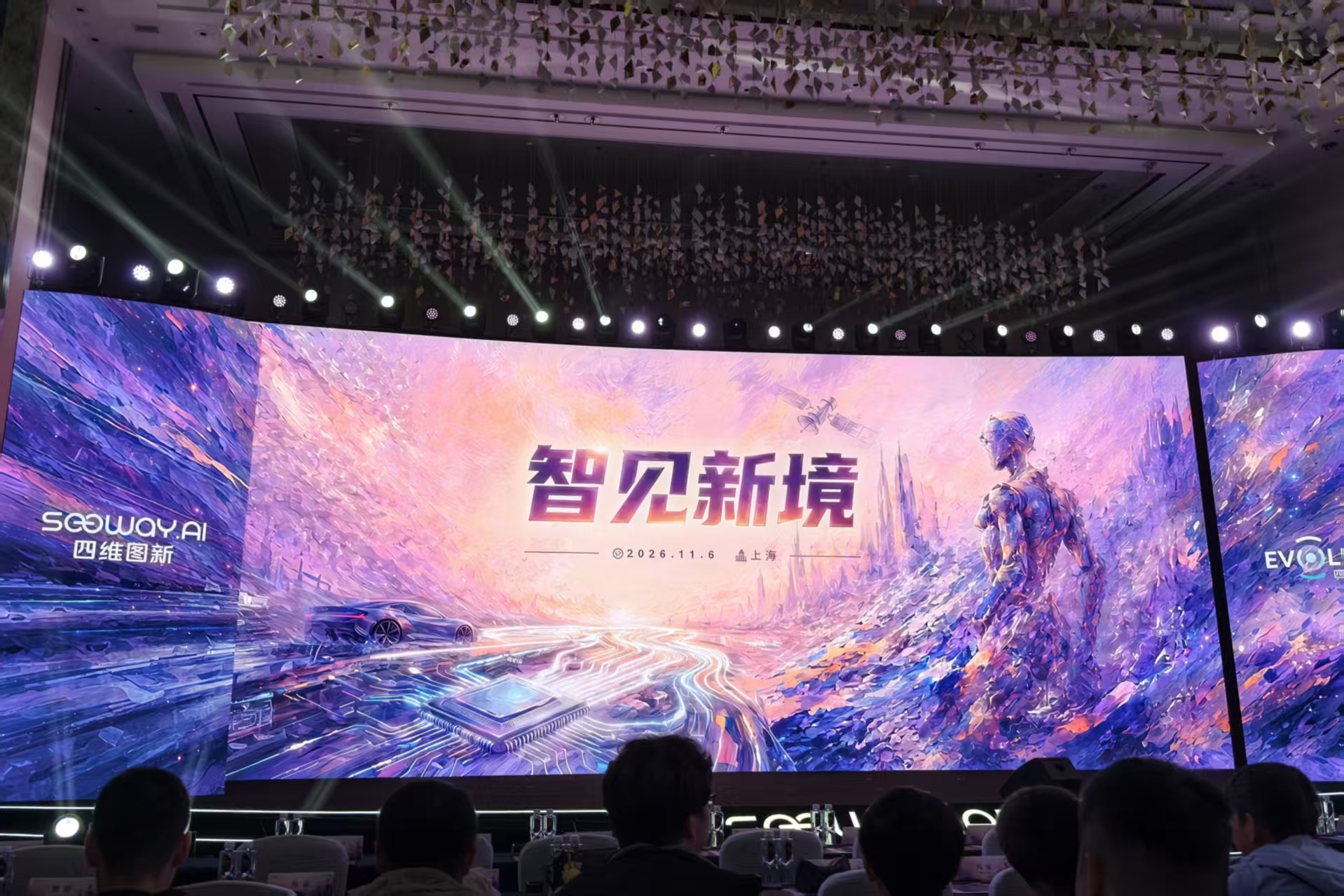

The next chapter of competition in the automotive industry is beginning to unfold. Over the past few years, automakers have largely competed on electrification and price. But as electric vehicles become more widespread, relying solely on price cuts and cost controls is no longer a sustainable way to gain an edge. What consumers are increasingly willing to pay for is a better product experience and tangible value delivered by technology.
Patrick Cheng, CEO of SEEWAY.AI, said data and computing power will become increasingly important to the next decade of competition in China’s automotive industry. Companies that can make better use of data, build reliable computing foundations and turn AI technologies into large-scale applications will be better positioned to compete in the next phase of the industry.
Last Friday, SEEWAY.AI held its 2026 EVOLUTION Innovation Conference in Shanghai. At the event, Cheng shared the company’s views on automotive intelligence, data compliance, global expansion and chip development, while also announcing its strategic move into the mobile intelligent agent market.

Data emerges as a second battleground for automotive intelligence
If battery technology helped drive China’s new energy vehicle industry over the past decade, data could become another major source of competitive advantage in the decade ahead, according to Cheng. From maps and positioning to vehicle operations and user behavior, cars generate vast amounts of data every day. But the growing volume of data does not necessarily mean its value is being fully realized.
Cheng noted that more than half of the data collected by automakers may remain idle or underutilized. Repeated data collection, inadequate planning, and high storage and processing costs all affect how efficiently the data can be used. The challenge for the industry is therefore not simply to collect more data, but to improve how it is governed, shared and put to use.
Meanwhile, data compliance has become a key challenge for Chinese automakers expanding overseas. Different countries and regions have different requirements for data protection, privacy and cross-border data transfers. Automakers need to factor local regulations into product planning rather than address compliance issues only after entering a market.
As a company with around two decades of experience in data technologies, SEEWAY.AI claims to have completed over 170 data compliance projects for more than 60 automakers and other industry clients. It also provides support in areas such as overseas data compliance, localized data centers and cloud services.
The company is also working with Huawei HMS for Car on potential applications in global navigation, in-car voice interaction and connected vehicle services.

Expanding its automotive chip portfolio
Realizing the value of data requires a solid computing foundation. As vehicles become increasingly intelligent, automotive-grade chips are also gaining importance. SEEWAY.AI’s subsidiary AutoChips has developed two major product lines: system-on-chips (SoCs) and microcontrollers (MCUs).
Its automotive SoC lineup has reached its sixth generation, with the chips adopted in more than 100 mass-produced vehicle models for overseas markets, according to the company.
Among its products, the AC8015 has been installed in around five million vehicles. Looking ahead, the company is developing its next-generation AC8035 chip to meet growing demand for intelligent cockpits and cockpit-driving integration. The chip is designed to deliver stronger computing and AI capabilities, supporting high-performance smart cockpits and large AI model applications. It is scheduled for launch in the first quarter of 2027.
As large AI models gradually make their way into vehicles, intelligent cockpits are evolving beyond voice controls and multi-screen interaction. More AI applications are expected to run directly on vehicles, placing higher demands on chip performance and system integration.
In the MCU segment, SEEWAY.AI’s four generations of automotive-grade products are used in over 300 mass-produced vehicle models, Cheng said. Its flagship AC7870 features a six-core Arm Cortex-R52 architecture and meets the ASIL-D functional safety standard. It is designed for critical applications including electric vehicle powertrain systems, power domain controllers and electric power steering.
Through its SoC and MCU offerings, SEEWAY.AI aims to provide automakers with more comprehensive solutions by integrating chips, algorithms, software and development tools.

From intelligent driving to AI cockpits, bringing technology into mass production
With data and computing power in place, the next challenge is turning technology into products that can be deployed at scale.
In the advanced driver-assistance systems (ADAS) segment, SEEWAY.AI has introduced an integrated driving and parking solution priced below RMB 1,000 ($150). Paired with Horizon Robotics’ Journey 6B chip, the solution delivers 18-20 TOPS of computing power and supports Level 2 ADAS and automated parking functions. It has secured design wins for a cumulative 2.7 million units, according to Cheng.
SEEWAY.AI said its investee company, Siwei Zhilian, has shipped more than four million intelligent cockpit units. Its products are used by over 30 customers in more than 100 countries and regions.
At the conference, SEEWAY.AI also unveiled an AI-native intelligent cockpit solution targeting global markets and discussed international cooperation with Microsoft.
The two companies plan to combine SEEWAY.AI’s expertise in intelligent cockpits, mapping and data compliance with Microsoft’s global cloud infrastructure, multilingual voice technologies and AI ecosystem to provide integrated solutions for Chinese automakers expanding overseas.

Beyond automotive, SEEWAY.AI looks to mobile intelligent agents for growth
Beyond the automotive sector, SEEWAY.AI is extending its technological capabilities into a wider range of mobile intelligent agent applications.
Cheng explained the company’s new positioning as a super partner for mobile intelligent agents. He believes that the experience accumulated in automotive intelligence, including real-world perception, data processing and mass production, can also support the development of embodied AI.
SEEWAY.AI’s RND spatiotemporal dataset has supported 22 participating embodied robotics companies at the 2026 Beijing Yizhuang Humanoid Robot Half Marathon, providing data support for autonomous robot running. The company is also developing products such as binocular vision fusion perception terminals and fine-motion capture gloves. These products support data collection across a range of scenarios, from spatial environments to human hand movements.
Two-wheeler intelligence is another emerging business area. SEEWAY.AI is extending its automotive-validated chip, software and system solutions into the two-wheeler market. Its related products have secured project nominations from 20 OEMs and entered mass production in models from manufacturers including Zhang Xue Motorcycles.
From map data and automotive chips to AI and embodied intelligence, SEEWAY.AI is continuing to expand the scope of its business.
Over the next decade, competition in the automotive industry may depend less on any single technology and more on the integration of data, chips, software, AI and global service capabilities. For SEEWAY.AI, the key will be turning its accumulated technological expertise into products and solutions that can be deployed at scale as the industry enters its next phase.