AI optimism meets data center backlash as protesters disrupt Seattle AI Week kickoff
Climate activists from the group Troublemakers interrupted the opening panel of Seattle AI Week several times on Monday, objecting to the push to build more data centers. Former Gov. Chris Gregoire, Gov. Bob Ferguson’s policy advisor and Seattle business leaders used the event to argue that Washington needs to do more to stay competitive in AI. Read More

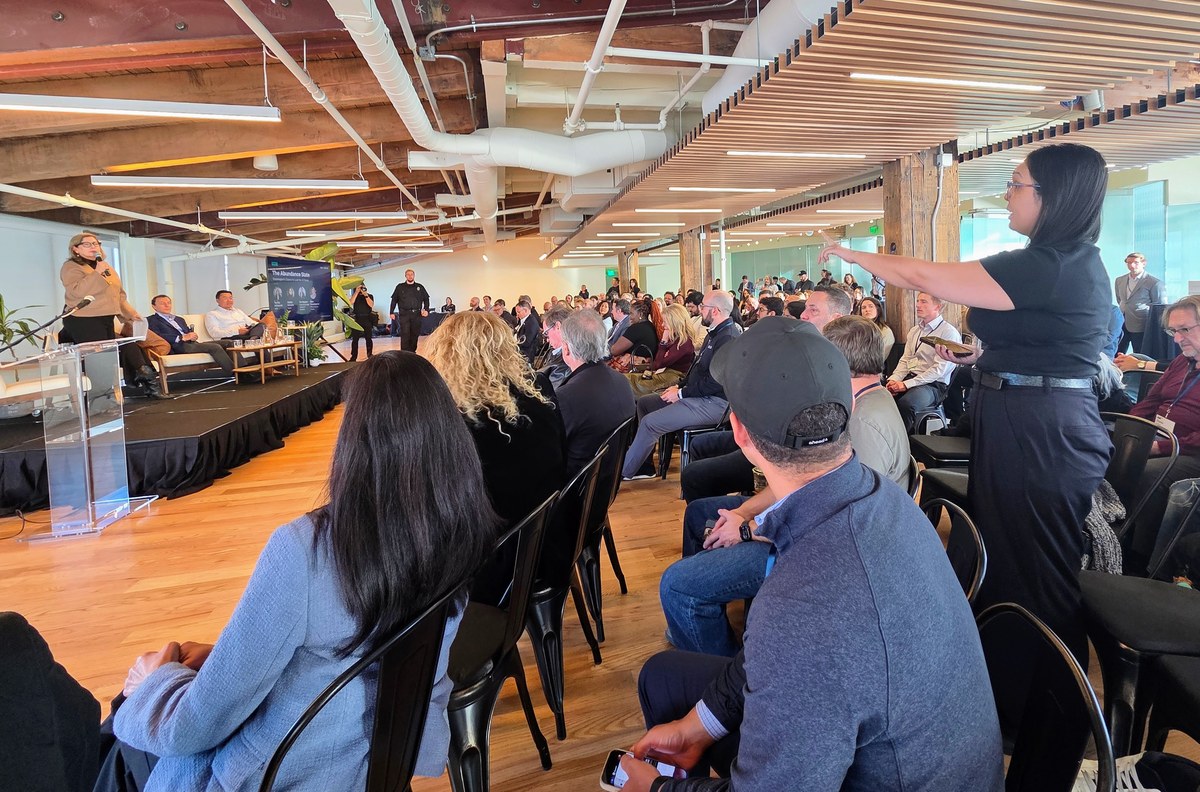
The Washington Technology Industry Association kicked off the third annual Seattle AI Week on Monday with a reminder that AI affects everyone, from engineers and artists to “someone who learned about ChatGPT today,” as WTIA’s Nick Ellingson put it.
“All of us should be a part of that conversation,” he added.
A few people in the audience took that statement literally.
Members of Troublemakers, a Seattle climate activism group, interrupted the week’s opening panel on AI and economic growth several times before they were led out by security. Outside on Elliott Bay, others floated in kayaks with a banner: “Power for People, Not for Tech.”
“These are not your constituents — we are,” one protester told Beau Perschbacher, Gov. Bob Ferguson’s senior policy advisor, as he addressed the large crowd of tech and startup leaders at Seattle’s AI House. Perschbacher was on a panel with Joe Nguyen of the Seattle Metropolitan Chamber of Commerce and Mattie Zazueta of OpenAI, the event’s presenting sponsor.
The group’s main message, according to members who spoke with GeekWire: the rush to build data centers and roll out AI is putting the state’s communities, jobs and environment at risk, and Washington should be investing in green jobs and clean energy instead.
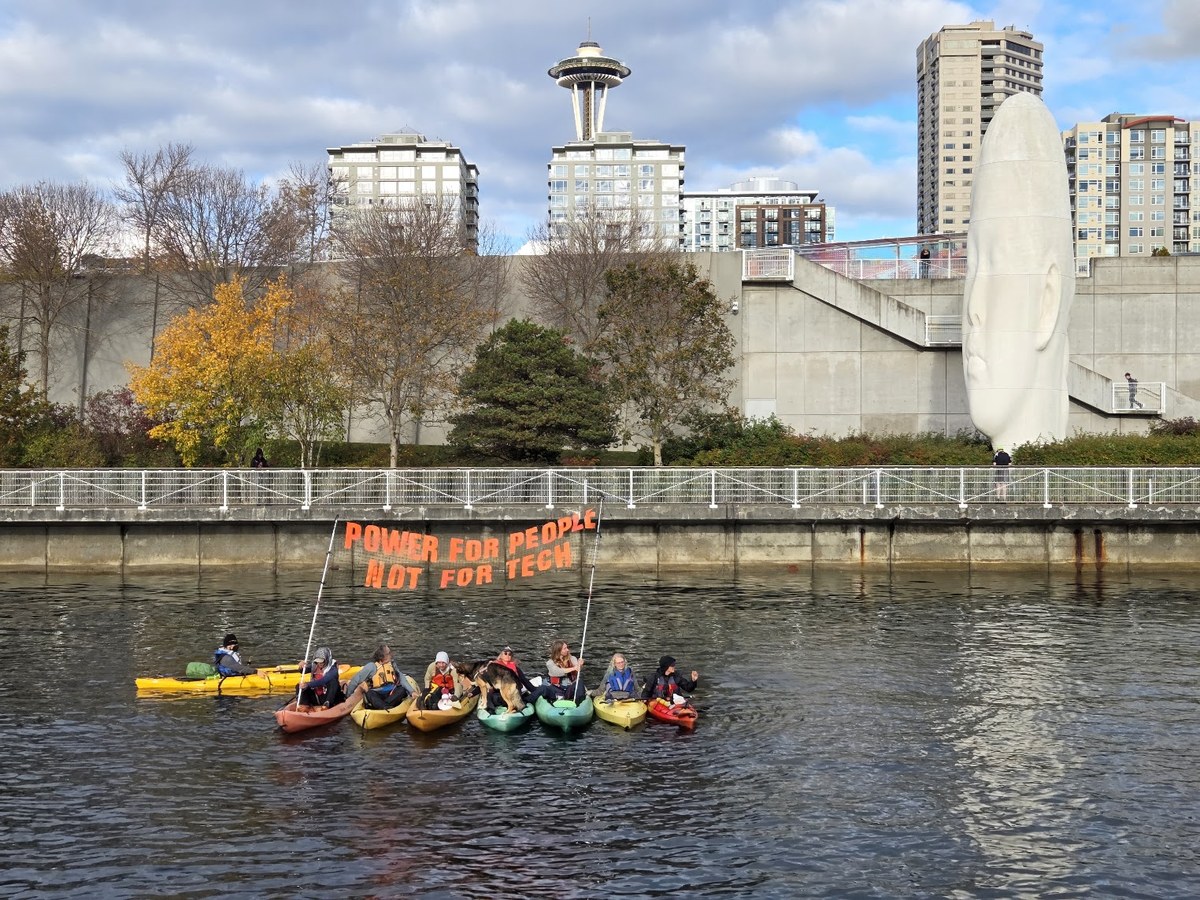
The protest comes amid a broader backlash against data centers in Washington state and across the country. The Seattle City Council voted unanimously in June to pause new large data centers in the city for a year, and Washington AI Resistance organized at least 19 protests around the state this month calling for a statewide moratorium.
The event also came the same day Microsoft offered voluntary buyouts to about 60,000 employees, roughly a quarter of its workforce, as it spends tens of billions of dollars on data centers and AI infrastructure.
The backlash contrasts with a push from the business and tech community for Washington state and the Seattle region to do more to stay competitive in the AI era.
“Washington helped build the technology economy of the last generation. We have an extraordinary opportunity to lead the AI economy of the next,” said former Gov. Chris Gregoire, now CEO of the business group Challenge Seattle, in her opening remarks at the AI Week event.
Gregoire cited efforts to put AI to work on the region’s own problems, including an AI permitting pilot in Everett that she said could cut the median wait for an accessory dwelling unit permit from 252 days to 90. She highlighted the AI-driven protein design work of Nobel laureate David Baker of the University of Washington, with applications in areas including the environment, agriculture and health care.

She also warned that Washington is close to the bottom for its business climate, even though it ranks second in North America for tech talent, as other states court its companies and jobs.
On the panel, Perschbacher said Ferguson’s administration has been focused on data centers since taking office, setting up a work group early last year to study their impact. The group looked for a Washington community that had been harmed by a data center and couldn’t find one, he said.
He added that the state won’t permit data centers to run diesel generators around the clock, and that their water use turned out to be “not out of line with a typical industrial user.”

Electricity is a different story. Data centers “use a really significant amount of electricity,” he said, and with demand also rising from EVs and heat pumps, getting enough power “is a major challenge.”
Perschbacher addressed the protesters directly, saying Washington has some of the strictest environmental laws in the country and that the state’s data center work group reinforced those rules rather than weakening them. Bills on ratepayer protections and transparency for data centers are likely to come back in the next legislative session, he said.
The issue also came up in the event’s second panel, on AI policy. State Sen. Marko Liias, who sponsored a bill this year on high-risk uses of AI, said data centers that want to locate in Washington need to meet “stringent expectations,” including adding clean energy to the grid, recycling water and dropping nondisclosure agreements that keep communities in the dark. Washington’s goal “has never been to be the cheapest or easiest place,” he said.
“When energy becomes scarce, I do think we need to be clear that our communities deserve access to that energy before the data centers do,” Liias said.
Joe Braidwood, founder of AI governance startup Glacis, which works out of AI House, said on the same panel that it was the first event he’d attended there with a public protest. “I think that’s actually kind of promising that people care enough to want to come together and talk and disagree and figure this out,” he said.
Zazueta, OpenAI’s global head of community programs, said in the opening panel that the industry needs to do a better job showing people the benefits of AI. Many people “read about these scary headlines,” she said, but don’t see how the technology applies to their daily lives.
OpenAI runs AI literacy workshops and trains libraries and community groups to lead their own, she said. The company opened an expanded office in Bellevue in March, its largest engineering center outside San Francisco.
Speaking with GeekWire outside the event on Monday afternoon, one of the protesters who had interrupted the panel singled out that remark. She said it dismissed public concerns about AI as the product of bad headlines, and she objected to the idea of using community groups to win people over to the benefits of artificial intelligence.
“They want to infiltrate our communities,” she said.
The opening panel with Zazueta, Perschbacher and Nguyen was titled “The Abundance State: Washington’s Chance to Lead the AI Future.” The protester objected to that framing, saying the panelists’ idea of abundance came down to easing permits for data centers.
It wasn’t the first time the group has protested the tech industry’s energy use. In 2024, it blocked entrances at Amazon’s Seattle headquarters to protest the company’s plans to power data centers in Oregon with natural gas.
Inside the event on Monday, as the interruptions continued, Nguyen, a former state senator who now leads the Seattle chamber, had responded to the protesters directly. “If you want to have your own event, have your own event,” he told them.
After they were led out, Nguyen said he agreed with the protesters, calling their passion “very warranted.” Those concerns are one reason Washington created some of the most stringent energy policies in the country, he said, adding that everyone would be better off if data centers elsewhere were held to the same standards.
“I think we’re very unique in Washington state to be able to actually do this in a way that really is mindful of our values, of the environment, and also pushing for innovation as well,” he said.
At the same time, Nguyen said demand for AI and data centers is market-driven, and it isn’t fair to criticize data centers while using them every day.
“For anybody who’s upset with data centers, I hope that when you email me, don’t email me,” he said. “Print it off and walk it to my office.”
Note: GeekWire’s Todd Bishop is interviewing OpenAI’s Vijaye Raji on stage Tuesday morning at WTIA’s Seattle AI Summit, part of Seattle AI Week.