ByteDance Is Rewiring Its AI Video Bet
ByteDance is consolidating two of its AI video products. ByteDance’s CapCut unit recently folded Xiaoyunque into Jimeng while keeping Xiaoyunque’s standalone entry point. Xiaoyunque focuses on automated short-drama production, turning scripts into storyboards and finished episodes, while Jimeng is a broader AI creation platform for image and video generation and editing. Their functions have increasingly […]



ByteDance is consolidating two of its AI video products.
ByteDance’s CapCut unit recently folded Xiaoyunque into Jimeng while keeping Xiaoyunque’s standalone entry point.
Xiaoyunque focuses on automated short-drama production, turning scripts into storyboards and finished episodes, while Jimeng is a broader AI creation platform for image and video generation and editing. Their functions have increasingly overlapped as both move toward end-to-end video production.
Jimeng has absorbed Xiaoyunque’s short-drama capabilities; its operations will now be overseen by Jimeng’s operations and marketing head, while the product team remains unchanged.
The immediate rationale is resource concentration. Both products are still growing, but that user growth has yet to generate returns commensurate with investment, while a proliferation of video-agent products is narrowing the room for differentiation.
From App Race to Workflow Race
That pressure is visible across the market. Kuaishou’s Kling 4.0, released this month, supports longer generation, multimodal references and keyframe control. MiniMax’s H3 is likewise targeting commercial uses including advertising, e-commerce and gaming.
The competitive frontier is moving from basic text-to-video generation toward controllable, end-to-end production workflows. Xiaoyunque has evolved into a specialized short-drama workflow, while Jimeng is moving from general image and video generation toward professional creation.
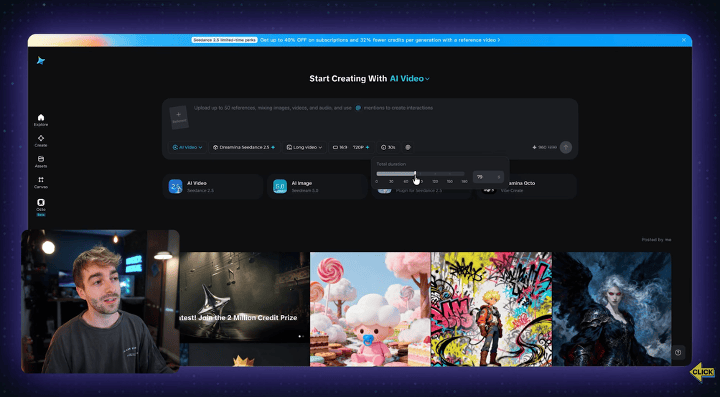
ByteDance has also been repositioning Jimeng itself. Before China’s October holiday, the company reduced investment in Jimeng’s consumer app and shifted resources toward its professional web product, overseas version Dreamina, and commercialization.
The recent consolidation may therefore allow ByteDance to preserve Xiaoyunque’s specialized short-drama capabilities while reducing duplication across two increasingly overlapping products.
The Model May Be the Stronger Business
The more consequential competitive shift sits underneath those applications: Seedance.
ByteDance has made Seedance 2.5 available through Volcano Engine APIs, allowing companies and developers to build its video-generation capabilities into their own products. The model supports text, image, video and audio inputs, as well as video editing and extension.
Volcano Engine’s documentation shows the model supports text, image, video and audio inputs as well as video editing and extension.
Revenue from Volcano Engine’s Seedance model-as-a-service (MaaS) business is substantially higher than revenue from Jimeng and Xiaoyunque. That means some apps competing with ByteDance’s own creation tools can also be customers of its underlying model.
This raises the bar for ByteDance’s own apps: if Seedance can earn revenue through third parties, each in-house product must justify itself through growth, retention, or monetization.
Beyond the App Shuffle
The restructuring looks less like a retreat from video than a reshuffling of ByteDance’s bets.
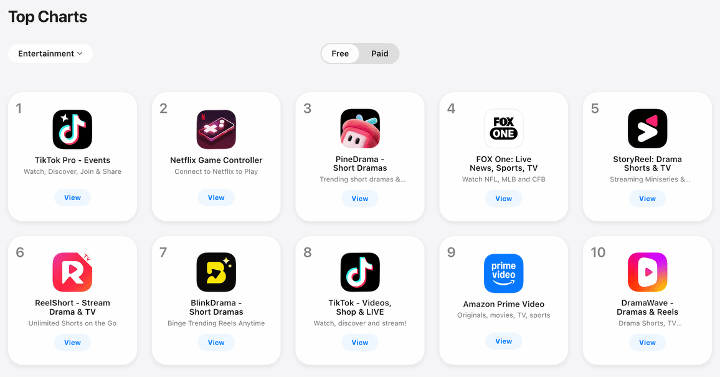
While consolidating its AI creation tools, ByteDance is still expanding in distribution. Its overseas short-drama app PineDrama has entered the top 10 free iPhone apps in the U.S., Brazil and Thailand, backed by an ad-supported model, TikTok traffic and ByteDance’s content ecosystem.
The moves may suggest a more layered strategy: grow consumer platforms for distribution, focus creation tools on professional workflows, and monetize Seedance by supplying its technology to other companies.
As AI models improve, standalone creation apps are becoming easier to copy, shifting more power to the companies behind the models. For ByteDance, the challenge is deciding where it can still stand out.