The more staggering the financial results, the less room there is for Jensen Huang to turn back.
Author: Kuli, TechFlowTechFlow Preview:On November 17 ET, NVIDIA released its first quarterly earnings report without Jensen Huang hosting, with Q3 revenue surging 103% to a record $115.84 billion. The data center business and a 75% ultra-high gross margin completely overshadowed market expectations, while the fourth-quarter guidance was raised directly to $130 billion.However, this brilliant financial statement not only failed to pave the way for Huang’s public morning apology and potential return to the CEO role, but instead became the board's strongest card to immediately announce they would absolutely not consider reinstating him. Analyzing the business structure behind this report reveals that the certainty the board currently holds is essentially consuming the order momentum and ecosystem dividends that Huang built up over the past few years himself.The trillion-dollar figure provides NVIDIA with a sufficient safe harbor in the short term, but when this legacy—maintained by the f

Author: Kuli, TechFlow
TechFlow Preview:
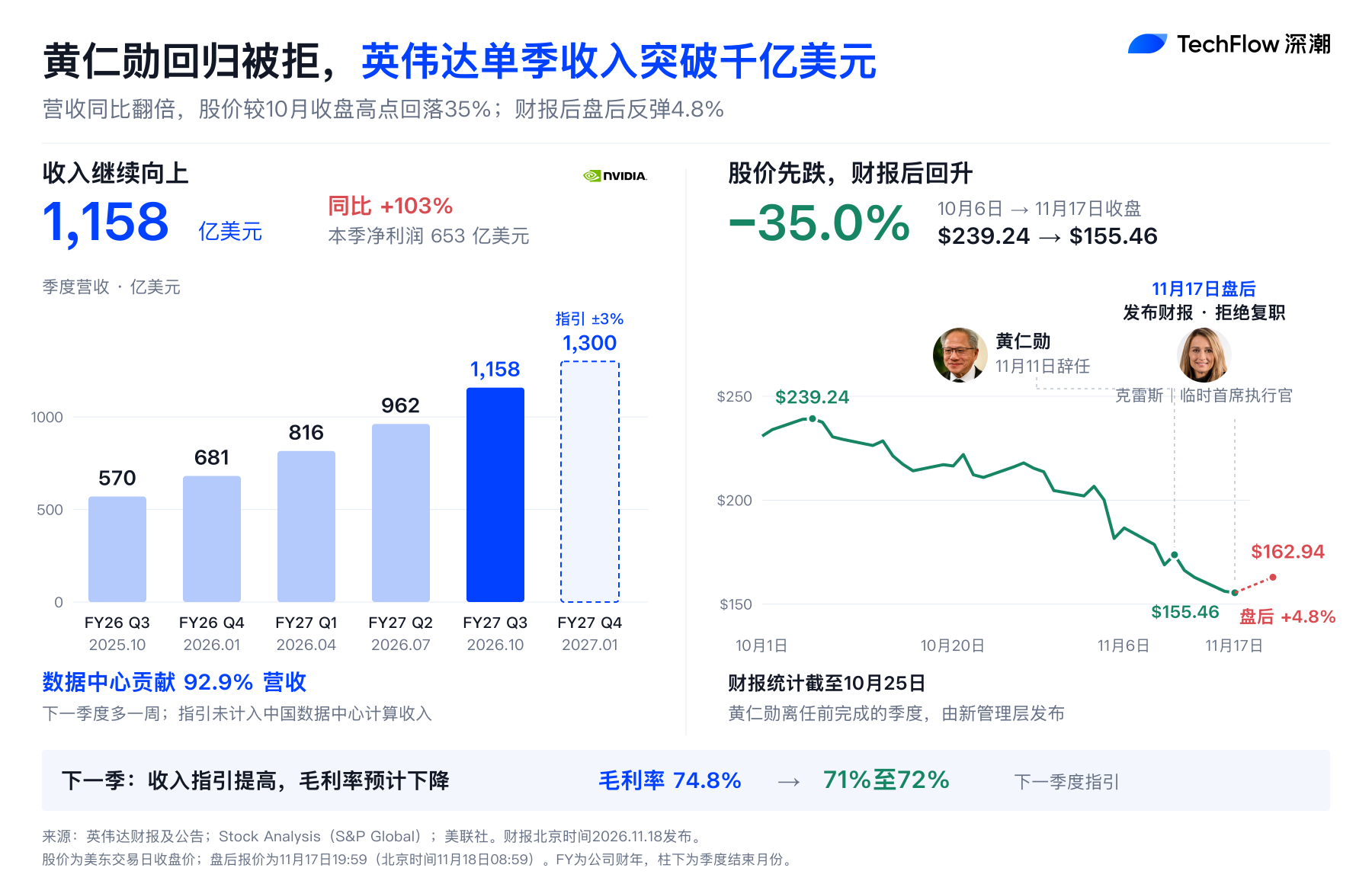
On November 17 ET, NVIDIA released its first quarterly earnings report without Jensen Huang hosting, with Q3 revenue surging 103% to a record $115.84 billion. The data center business and a 75% ultra-high gross margin completely overshadowed market expectations, while the fourth-quarter guidance was raised directly to $130 billion.
However, this brilliant financial statement not only failed to pave the way for Huang’s public morning apology and potential return to the CEO role, but instead became the board's strongest card to immediately announce they would absolutely not consider reinstating him. Analyzing the business structure behind this report reveals that the certainty the board currently holds is essentially consuming the order momentum and ecosystem dividends that Huang built up over the past few years himself.
The trillion-dollar figure provides NVIDIA with a sufficient safe harbor in the short term, but when this legacy—maintained by the founder's personal reputation—is eventually depleted, the chip empire lacking a soulful leader will have to face customer self-developed chips and architecture iterations alone.
Over the past 24 hours, NVIDIA used a solid financial report to temporarily put an end to the clamorous drama surrounding the founder's attempted comeback.
Early on the morning of November 17, Huang broke his silence after stepping down through media outlets, publicly admitting fault with a rare low profile. He acknowledged bringing deeply regrettable issues to the board and explicitly stated that if needed by all parties, he would be honored to respond to calls to resume his role as CEO. Bolstered by this news, NVIDIA's market cap surged by approximately $90 billion in just 10 minutes.

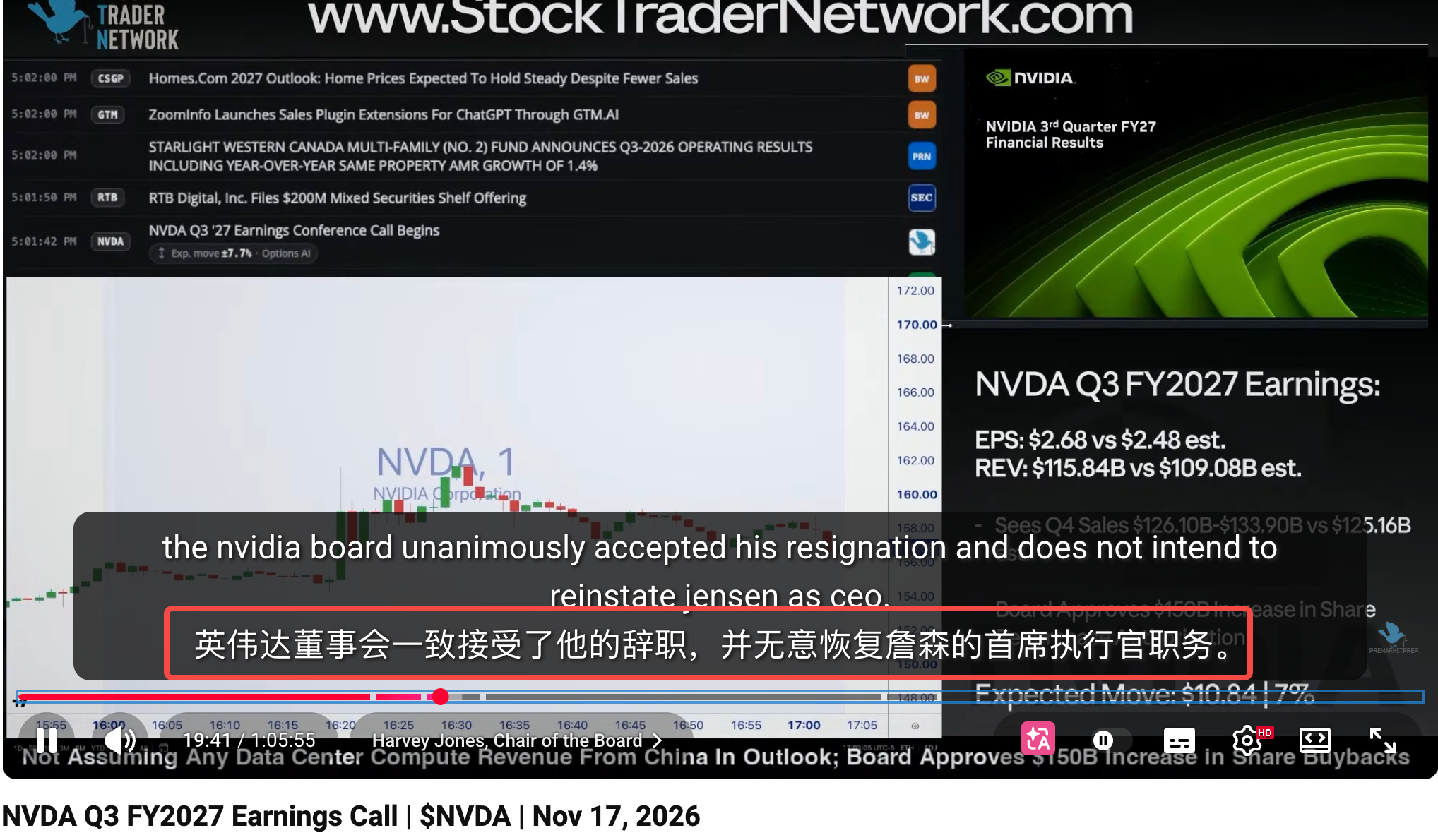
However, merely a few hours later, at the very start of the after-hours earnings call, NVIDIA Board Chair Harvey Jones used the phrase "no room for maneuver" to immediately announce that the board had unanimously accepted his resignation and had no intention of reinstating Huang, and had already formally hired global search firm Heidrick & Struggles to find a new CEO.
Many are baffled by the board's decisiveness, but if you thoroughly break down this freshly released trillion-dollar report, you can see the true calculations behind this power clash.
A $115.8 Billion Revenue Report: The Board's Confidence in Shutting the Door On the Spot
The reason the board could firmly seal the doors amidst a media storm of petitions from tens of thousands of people and pressure from major shareholders is that every core dataset in the report provides them with immense confidence.
First is the absolute monopoly in the data center business. Of the $115.84 billion total revenue achieved in Q3, the data center segment contributed over $103 billion, representing a year-over-year growth rate of 112%. This means that NVIDIA has not only been unaffected by executive turmoil, but its money-printing machine selling computing power to global tech giants is spinning even faster.
An even more critical support lies in the explosive growth of the networking business segment. Driven by the widespread adoption of Spectrum-X Ethernet and InfiniBand architectures in hyperscale clusters, NVIDIA's networking revenue surpassed $11 billion in a single quarter, doubling year-over-year. Data proves that what major cloud providers are purchasing is no longer just compute GPUs, but NVIDIA's bundled, monopolized suite of AI factory communication standards.
Second is profit resilience rarely seen in manufacturing history.
Against the backdrop of continuously rising hardware costs, NVIDIA's adjusted gross margin for the quarter remains steadily pinned at a high of 75.1%. This indicates that in today's high-end computing market, NVIDIA still possesses undisputed absolute pricing power. Customers are not only scrambling for inventory, but also fully absorbing its premium markups.
Finally, there is the complete lock-in of future performance guidance. During the call, management set the fourth-quarter revenue guidance directly at $130 billion, which again significantly exceeded Bloomberg analyst expectations, and even raised the long-term compound annual growth rate expectation for FY2028 from 70% to 75%.
Parsed together, these three sets of figures form the hardest shield in the board's hands.
In the eyes of Wall Street and Washington, NVIDIA does not appear as a company mired in a leadership crisis, but rather as an automated machine with orders fully booked for the next 12 to 18 months and highly predictable cash flows.
The Assembly Line Takes Shape: Does Capital No Longer Need Risk-Taking Personal Heroes?
Bearing purely commercial considerations in mind, since accounting performance has already soared to hundreds of billions in a single quarter, the board has no reason at this juncture to risk enormous compliance hurdles and political scrutiny to drag a founder embroiled in a public relations whirlwind back into the cockpit.
During the early and expansion phases of corporate development, a company relies heavily on the obsessive technological foresight and personal gravitational field of founders like Huang. His 20-year insistence on building the CUDA ecosystem forged the 75% gross margin, his determination against conventional wisdom to acquire Mellanox built a tens-of-billions networking business, and the tacit understanding forged over drinks with TSMC secured production capacity. At this stage, the founder's personal will is the company's core asset.
But once a company's quarterly revenue crosses the hundred-billion dollar mark and its market cap stabilizes above $4 trillion, the primary demands of the enterprise quietly undergo a qualitative shift.
NVIDIA today no longer needs disruptive, all-or-nothing gambles; what it needs most is certainty, smooth transition, and regulatory compliance. Huang's personal authority, deep private networks, and borderline maneuvers that could easily trigger investigations from Washington were once sharp blades for capturing territory, but today they have become the most unmanageable systemic risks for a compliance-bound giant.
Historically speaking, this is not a plot unique to NVIDIA.
When Tim Cook succeeded Steve Jobs, and Satya Nadella succeeded Steve Ballmer, every tech giant that reached the peak ultimately underwent a transformation from personality cults to modern governance structures.
The board did not leave the door open for the "Old Huang," because they certainly believe that right now, this machine has grown too large to compromise for any individual special case.
"The 'Post-Huang' Era"
The trillion-dollar report provides a respectable backdrop for Huang's departure and completely tears off the old labels from NVIDIA.
For NVIDIA, which holds massive amounts of highly certain orders, the foundation of its performance will not waver in the coming quarters, nor for the next one to two years. A professional management team is fully capable of relying on existing generational product advantages to methodically convert their order book into polished financial statements.
But long-term evolution often shifts in deeper waters.
After parting ways with a founder who worked 14 hours a day and was willing to shoulder all strategic risks, NVIDIA will inevitably transform from a geeks-pioneered offensive vanguard into a standard blue-chip giant.
It will become more compliant, its management structure more standardized, and its response to external political and legal challenges more measured; yet simultaneously, when facing future architectural upheavals or the next wave of disruptive technology, whether this precision assembly line can still muster the guts to push forward with an all-or-nothing reset as it did years ago will be the long test question left by the new management team for time itself.
Huang personally crafted a computing empire that raked in $115.8 billion in a single quarter, but he perhaps never anticipated that this leviathan he forged with his own hands would ultimately use flawless financial data to prove that it no longer needs the shelter of its founding god.
The trillion-dollar report seals a door behind, and NVIDIA's post-Huang era officially begins tonight.