Uncommon Thinkers: Andrew Redd’s audacious plan to turn ocean volcanoes into power plants
When Andrew Redd saw AI and electrification driving a new wave of natural gas plants, he made a checklist of what a better energy source would need, and undersea geothermal ticked every box. So he left SpaceX to launch Endurance Energy, which recently generated more electricity than it used on the seafloor. Read More


Editor’s note: This series profiles five Seattle-area “Uncommon Thinkers,” who will be recognized Dec. 10 at the GeekWire Gala in partnership with Greater Seattle Partners.
Andrew Redd‘s career path creates a tidy narrative: grow up in Seattle steeped in aviation and maritime culture, study mechanical engineering and aerospace, work at SpaceX, then launch an offshore geothermal energy startup.
The dots connect, but the picture they form is anything but ordinary: bold in vision, fast in execution and enormous in potential.

Redd has next-level ambition, and he’s directing it at solving one of the world’s biggest and most urgent problems — adding renewable, massively scalable energy that can outcompete fossil fuels and reach the grid quickly enough to make a difference in the race against climate change.
Underwater geothermal energy has never been tapped in a significant way, but to Redd, the idea was irresistible. “It checks all of the boxes for our perfect future energy source,” he said.
So Redd set out to build it.
He founded Endurance Energy on the north shore of Seattle’s Lake Union in January 2025, and this September the team oversaw its fifth deep-sea deployment. At a site 300 miles off the Oregon coast, its prototype system generated more electricity than it consumed. The startup has raised $63 million from investors and has roughly three dozen employees.
Nate Bek, a principal at Ascend, praised Redd’s ability to attract “brilliant” talent in pursuit of his goal. The Seattle venture firm is one of the startup’s early backers.
“I’ve been deeply inspired by what [Redd]’s building at Endurance and haven’t shut up about it since the day we met,” Bek said. “He somehow makes powering the world from the bottom of the ocean feel inevitable, all while remaining remarkably measured and transparent about the progress.”
Keeping the world wide open
For Redd, studying engineering and aerospace in college was so clear-cut that it wasn’t a choice at all. Growing up around Boeing, seaplanes, the Museum of Flight and the Pacific Northwest’s rich maritime industry naturally pointed him toward those sectors. He wanted a degree as expansive as his influences.
“I didn’t really want to have to choose whether it was going to be boats or space travel or airplanes,” he said. “I just wanted to be able to do anything — keep the world as wide open as possible.”
After graduating from Princeton University, Redd worked at Neuralink, an Elon Musk company developing technology that lets the brain communicate directly with computers. A year later, in 2021, he moved to Musk’s rocket company, SpaceX.
That was another no-duh decision, as Redd viewed it.
“I saw SpaceX as really the place to be, where early-career people are given the most amount of resources and responsibility, and that felt like the fastest way to learn and the most engaging possible scenario to be in,” Redd said. “I wanted to be tossed into something that was a little bit crazy.”
Redd joined as SpaceX was starting to build its first orbital Starship rockets. The program brought together passionate young people and experienced SpaceX engineers who served as mentors. Wild ideas were entertained and explored. Everyone was committed to the mission. It was just the experience Redd wanted, and he planned to stick around for seven to 10 years.
Then artificial intelligence started booming.

Checking all the boxes
In 2024, the build-out of sprawling, energy-hungry data centers for AI was accelerating with no end in sight. At the same time, efforts to electrify transportation, heating and cooling were driving up demand for power. Redd saw these trends sparking a surge in new natural gas generation, locking in decades of carbon emissions.
He wanted to find a better way. He went into engineering mode, focusing on all the essential criteria for an energy source: it had to be clean, not dependent on intermittent sun or wind, capable of producing massive amounts of energy, readily deployable, subject to fewer regulatory hurdles than something like nuclear, economically competitive, and scalable.
Redd recognized the tremendous heat contained under Earth’s surface as a terrific source for renewable energy and realized that most of the world’s active volcanoes are offshore. The unknown was whether the rocky ocean floor would be suitable for geothermal wells, so he did some research and found publications from geology experts who said the conditions would be “perfect.”
Redd’s SpaceX days were over.
“You can tell,” he said, “when there’s a moment in time that you need to go and reach out and grab something, and that was really my impression — if I didn’t start this now, this would never come into existence, or wouldn’t come into existence soon enough to make a meaningful impact.”
From the lab to the seafloor
In launching Endurance, Redd was intentional about the culture he wanted to create. He was aiming for a multidisciplinary group of mission-driven employees eager to collaborate and learn from each other: top talent that would attract more of the same and make Endurance a place people were excited to work.
“The hardest part of an early-stage startup is recruiting,” Redd said, “especially if you’re a first-time founder.”
The startup employs about a dozen SpaceX alumni, plus employees from the fusion company Helion Energy and the aerospace venture Blue Origin.
A strong team is key to Endurance’s success. That’s because, enthusiasm and passion aside, the startup faces steep engineering and economic challenges. The technology must withstand high pressure, corrosive conditions and mineral scaling inside devices, and seafloor machinery could be costly to repair. The systems will need expensive subsea cables to carry power to shore over potentially long distances. It’s a heavy lift.
Net energy from a volcano
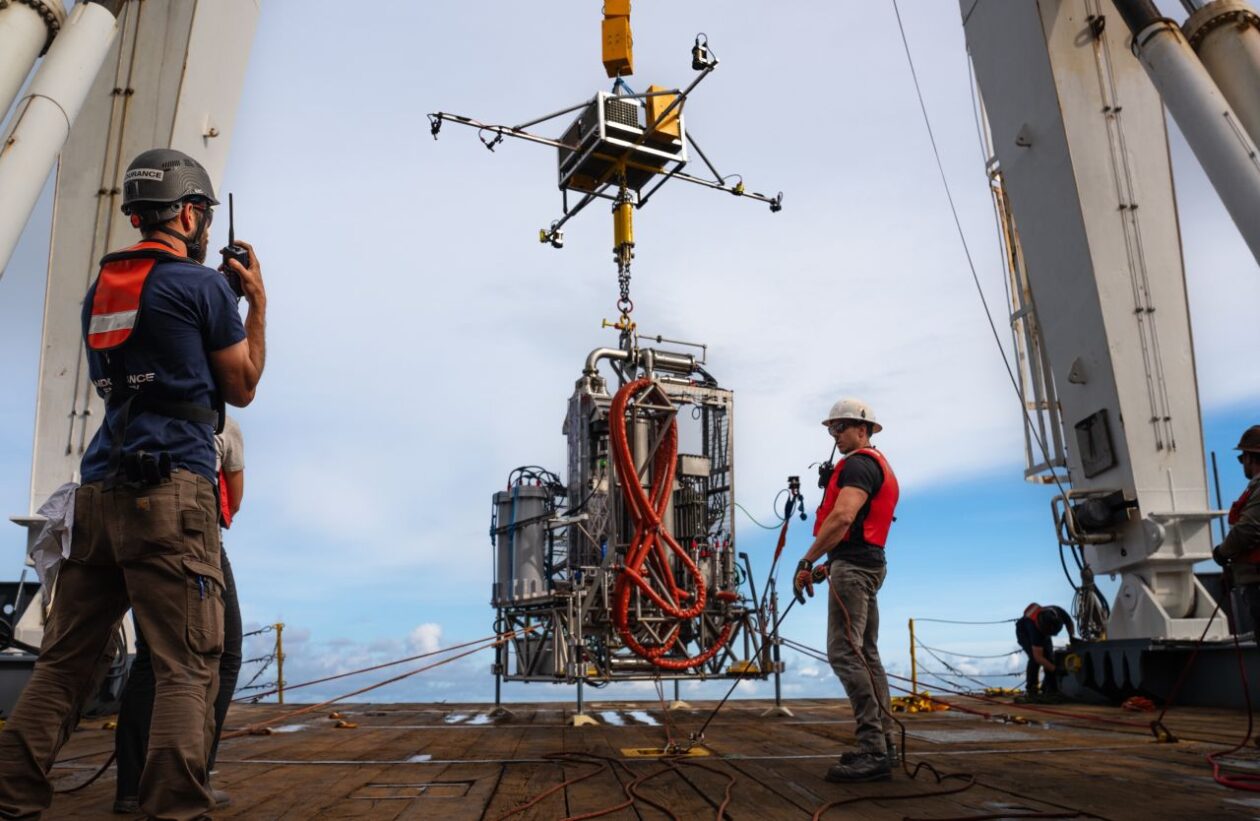
While the September sea trial didn’t go perfectly, Redd is happy with the results. The company landed its 3-ton power plant on the seafloor near a natural vent and produced net energy from it — albeit for only 8.7 seconds. Technical difficulties and a power-cable failure cut the dive short.
Team members successfully operated the system remotely from Seattle through a fiber-optic network running along the seabed. Redd said he’s grateful for access to the network, which is part of the National Science Foundation’s Regional Cabled Array and operated by the University of Washington.
Endurance engineers also drilled what they called the world’s first subsea geothermal well at a site about 5,000 feet below the ocean’s surface. The 2-inch-wide, 52-foot-deep well delivered hydrothermal fluid, but the flow was too restricted to run the power plant, sending the team to the natural vent.
Redd said there’s a lot of work ahead, but the team “made huge strides” in learning and in reducing the project’s risks.
The company now is developing Leopard, its 2-megawatt generator. After testing the technology at the research site off the Oregon coast, Endurance aims to deliver power from a Leopard system in Tonga next year as its first commercial project. Subsea geothermal energy could ultimately reduce the island nation’s reliance on imported diesel and put the startup one step closer to its objective of generating terawatts of planet-friendly energy.
“This was always the end goal,” Redd said. “Create something that is highly meaningful for the world.”
Editor’s Note: Nate Bek of Ascend is a former GeekWire reporter.